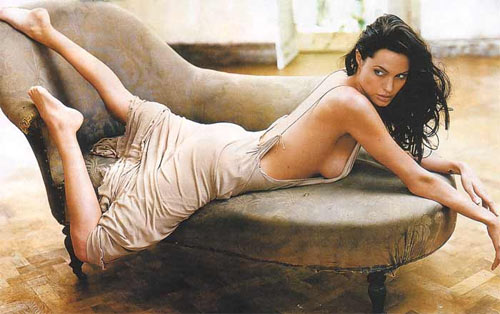
Sunday, March 30, 2008

Baseball

Overview: Baseball has been popular since its inception as a recreational distraction for soldiers back in Civil War times.* Years later, a “league” was formed, called the American Federalatory Association of Official Major League Play of Base-balling Activities, or “AFAOMLPBA”. The organization later changed its name to Major League Baseball , or “MLB”. The organization witnessed the early births of such still-popular teams as the New York Highlanders (now known as the Yankees), the Boston Americans (now known as the Red Sox), and the Philadelphia Shenaniganning Whistle-Whipping Never-Winners (probably the original name of the Phillies). In recent years, baseball’s popularity has skyrocketed, even becoming known as “America’s Pastime” (a distinction previously bestowed on other activities like “Twister”, Sudoku, and voting). What’s the big deal?

As mentioned in the introduction, baseball was created in 1862 during the American Civil War by Union soldier Montgomery “Johnny Shoeshine” McCallister*. McCallister got the idea for baseball when he was shot in the shoulder by a Confederate officer and wished he’d been quick enough to deflect the bullet with his sword. Following an agonizing, anesthetic-free surgery to remove the bullet with a rusty, blunt knife, McCallister decided to focus his thunderous post-surgery adrenaline rush on realizing this very fantasy. He found a smooth, round, rock and a dead fellow soldier’s makeshift wooden crutch and “batted” the rock with the crutch*. Legend has it that McCallister batted the rock 986 feet, which technically would have made it the longest home run in history, but legend also has it that the rock went foul.*

As the rust from the knife gradually coursed through McCallister's bloodstream and eventually reached his brain, he went into a fever-induced coma where, apparently, he had visions of men standing on an oddly (some might say “randomly”) shaped field, throwing rocks at rods of wood and running about, catching and hitting them in turns. McCallister later recounted specific details of his bizarre, nonsensical dream to a Union doctor, such as the rock appearing white and almost perfectly round, adorned with textured red “stripes”, game “rules” based on the trajectory and angle at which a ball is hit and how it subsequently does or does not land within the boundaries of the park, a barely-understandable anomaly called a “balk”, and other features of a delightfully whimsical, nonsensical nature.


Above: The realization of McCallister’s hallucinatory “stripey rock”, now know as a “baseball”.

McCallister was shortly thereafter killed in the battle of Fort William Henry*, but not before his nightmare-induced “game” was recreated with actual “players”, at first as a joke and shortly thereafter as the only reasonable means of escapism from the drudgery, horror, and misery of war!

*This story may not actually be true, since I made it up, but it sounds true.


Above: An early game of Baseball (then called “the base-balling game”) is played by Civil War veterans in the late 19th century. Note how, just as in today’s game, the players pictured above are all unusually toned and athletic and display the aura of someone paid millions of dollars to play a game for 6 months out of the year!

And here we are, almost one hundred and fifty years later and “Baseball”, as it is known today, is still going strong!

Some may marvel at the lasting appeal of Baseball, but that appeal can most likely be attributed to the elegant, intuitive simplicity of the game’s rules, which can be quickly and eloquently summed up as such:

-Baseball is divided into nine segments called “innings”. In every “inning”, each team is given the opportunity to “bat”, meaning they are in the offensive position, or “pitch” and “field” meaning they are in the defensive position. Once a team records three “outs”, the teams switch sides. Once both teams have recorded three “outs” per side, a new inning begins.

-Outs can be recorded in several ways.


  • First, a batter can “fly out”, which is not as cool as it sounds. In this case, a batter hits a ball and, before it touches the ground, it is caught by a fielder. The batter does not at any point fly during a fly out.
  • Second, a batter can “ground out”. Once a ball is hit, the batter must run to a “base”, and as the rules dictate, this must first be “first base” (followed by “second base”, the elusive “third base”, etc.). If the ball is not caught but is easy for a fielder to “field” (which means the same thing in Baseball as it does in real life, i.e. “to do something with”), the fielder can throw the ball to the baseman who then must either tag the base with his foot or, in the even that this is not a force-out (see below), tag the runner (which is the new name given to the batter after he has batted) with his glove (or “mitt”) once the baseball is safely secured inside his glove.

    -A force out occurs when a batter has no possible destination than the next base. Therefore, a batter running to first base will always be a force out situation. But if a runner is on second base during a base hit (see below) or a ground out, that runner is not in a force situation (as he is not required to move to third base as there is no one on first base who needs to advance to second base, where he is, theoretically, currently standing). Therefore, the baseman needs to tag this runner to record an out.

    -A base hit occurs when none of the stuff mentioned above happens.

  • Lastly, a batter may strike out. In this case, the batter doesn’t have a chance to run to base at all (except when he does; see below**)! A batter must attempt to hit “pitches” thrown towards him by the “pitcher”, who stands the logical distance of 60 feet, 6 inches from the batter. If the pitch passes through the “strike zone” (see Fig. 13b) -which is roughly measured as the imaginary rectangle formed by the points denoted by the batter’s knee or belt or something depending on the day and what the umpire feels like saying, the batter’s elbow (maybe?) or shoulder or something like that, and the outermost points of home plate- and the batter does not swing at the pitch or swings and misses the pitch, it is a strike. If it does not, and the batter does not swing at the pitch, it is a ball. (If the batter amasses four "balls" before he is out or strikes out, the batter is automatically awarded first base)


    Above: Fig. 13b - A computer rendering of a “strike zone”.

    The batter can also hit a “foul ball”. A foul ball is one that is hit in such a way so as the ball does not travel within the boundaries of the first base line and the third base line, or it does but drops to the ground before passing third or first base and then rolls outside of the line before passing either of those bases (see Fig. 83c)


    Above: Fig. 83c.-A computer rendering of potential “foul” and “fair” balls.


    If a batter hits a foul ball, it counts as a strike, unless the batter already has two strikes, in which case it counts as a nothing, unless the batter either “bunts” the foul (a batting technique whereby the batter tries to hit or “stop” the ball with a stationary bat without “swinging” the bat, resulting in a slow ball that falls not far from the plate and is difficult to field and that a fast base runner will be able to safely make it to first base on) or “foul tips” the ball (whereby the batter makes minimal contact, barely affecting the momentum of the pitch) into the glove of the “catcher”. In both these cases, the batter has struck out and his team is charged with an out, **unless the catcher, ball in hand, fails to tag the batter after the third strike, in which case the batter can run to first base and the catcher must throw the ball to the first baseman who must then tag the batter-now-runner before he reaches first base safely.The team to not do all of this stuff the most, within the span of nine innings, wins! And it all moves along at a brisk pace that generally takes no more than 3 – 4 and a half hours at a time!

(Note: for an explanation of pitching, see this Wikipedia article, with its dozens of easy-to-navigate links to more detailed specifics)

There are, of course, other, more complicated rules, but once one grasps these graceful, logical basics, the rest can be learned over time.As someone who has enjoyed baseball for some time, I can say, first hand, that after just a few years of daily, semi-obsessive baseball watching, I was able to pick up and fully grasp about 83% of its rules!

Baseball enthusiasts are called “fans”, and much of Baseball is marketed towards these “fans”.


Above: Alyssa Milano –One of the many things marketed to Baseball “fans”.


Above: Bitter, despondent “fans” of the Philadelphia Phillies look on in horror, anger, and resentment after their team probably found a remarkably new and innovative way to lose something again, but still bought Phillies-branded hats and T-shirts, for some reason.

It is recommended that, if you wish to explore the possibility of becoming a "fan", you should designate a favorite team. Most major cities have a "home team", or one that "represents" that city and plays a majority of its games therein.


Above: The Los Angeles Angels of Anaheim, a Baseball team that represents Los Angeles, Anaheim, and unnecessarily cumbersome team names.


I decided to become a "fan" of the relatively obscure Boston Red Sox, a scrappy team of underdogs and relative unknowns with an annual payroll barely in excess of 140 million dollars.

My early experiences with the Red Sox proved a mixed bag. While the team would often come close to "winning it all" at various points during the first twenty or so years of my experimentation with "fan-being", they found impressive ways to "lose it all", often at the last minute and usually at the hands of another barely-on-the-radar team, the New York Yankees. In fact, it took a solid 25 years before I witnessed them "win it all" (this is when a team wins something called the "World Series", so named because it represents two of the world's most important countries: America and Toronto).

This can be frustrating for a fan, and so it is not recommended that any new comer to baseball ever become a "fan" of one of the following teams: The Chicago Cubs, The Tampa Bay Rays, The Pittsburgh Pirates, The Washington Nationals, The Kansas City Royals, The Cincinnati Reds, The Baltimore Orioles, The Texas Rangers, and most importantly The Philadelphia Phillies. If you live in one of these areas, you are advised to pay lip service to the White Sox (since they have actually won the World Series in the last 100 years), embrace the Atlanta Braves/leave Florida, stick to Football, be glad your team has only existed for three seasons, keeping talking about the George Brett years (and make plans to move to a real city), become a Cleveland Indians fan, keep talking about how great Camden Yards is and bask in the fact that everyone enthusiastically agrees with you, see what the Houston Astros are up to, and practice praying/cringing/swearing/developing your pitching staff/hoping the Eagles will have a better season, respectively.


Above: The author (in an official Boston Red Sox hat, one of the many fine products adorned with the team's logo) probably watching his team lose against some wretched, undeserving other team that has the audacity to challenge his own, while sitting in the "stands" at the Red Sox official park, "The Fen-way Park".

So how can I sum this up? What about Baseball makes it so great?

For one thing, it has rivalries. Some of these include The Red Sox/Yankees rivalry, the White Sox/Cubs rivalry, and the Phillies/Whichever team provides a convenient scapegoat to blame their perpetual, crushing futility on rivalry. Rivalries really enhance the enjoyment of Baseball, because instead of just watching a game and hoping your favorite team wins, you can pretend you have/have had any influence over the wins and losses of your team and their rival and also can make yourself feel better about yourself by proving to your rival team's fans that what they think is wrong.


Above: A likely Red Sox fan (though I'm only guessing, since everybody totally hates the Yankees) expresses a well-thought-out and reasonable argument about the Yankees and their skills as a team, as an organization, and as something that totally sucks.

As with all great rivalries, the Red Sox/Yankees rivalry is in no way just a tired, meaningless and irrational obsession among fans, but goes right to the core of the organizations themselves and includes bitter, hateful relations between the teams' actual players!
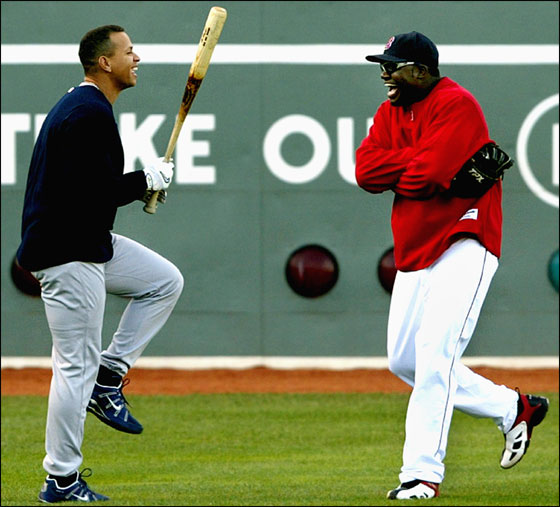

Above: Red Sox star David "Big Papi" Ortiz (at right) and Yankees star Alex "A-Rod" Rodriguez (at left) exchange bitter words. Papi probably was all like, "Hey, A-Rod! You suck, A-Rod" and then A-Rod was probably all like "What? No! Grrrrrrrrrrrrrrrrrrr! I'm totally gonna hit you with this bat!"


Another great thing about Baseball is the way it invites the popular activity of cheering.


Above: WHOOOOO!!!! Let's go (whatever this team's name is)!!!!!

Cheering can be directed towards teams, or even individual players.


Above: Ma-nny! Ma-nny! (Note, the blurry individuals in the background are fans "cheering", as evidenced by the raising of the arms over the head, a popular and common physical accompaniment to the vocalized "Whooooooooooooooo!")

On occasion, the "cheering" is done in a negative manner. This is often called "heckling" or "booing"


Above: New York Yankees Third Baseman Alex Rodriguez, a 3-time American League Most Value Player Award Winner, who last season batted .314 with 54 home runs and is widely considered the best overall player alive, and possibly ever, is mercilessly booed by New York Yankees fans after striking out, because he never ever does anything right and it's all his fault.


"Cheering" often happens when games are watched live, at the actual ballpark itself, where the enthusiasm of the hometown fans can actually have some indirect impact over the outcome of the game.


Above: Chicago Cubs fans, probably watching their team pull off another dominating post-season win, passionately cheer on their hometown heroes at the Cub's park,"Wrigley Field"


Quite inexplicably, cheering can also take place at sports bars, where fans often gather to watch games together, but on televisions. In such places, even ones with very thin walls located very closely to the stadium or park in which the games is being played, it is highly unlikely that the players will be able to hear the cheering fans, making the very act symbolic at best.

One downside to Baseball is that, on extremely rare occasions, fans can become so passionate that they start taunting or even becoming physically violent toward other fans. To help curb this problem, most venues sell beer, a chemical depressant, to help fans remain docile and calm.

Unfortunately, while this is an effective method of preventing fights among fans, players are not allowed to drink alcohol on the field, which can be problematic, especially among A.J. Pierzynski.


Above: Former Cubs catcher Michael Barrett finally does what everybody has secretly always wanted to do.

The other downside is that Major League Baseball is only played for almost exactly half a year, every year, and with a mere 162 games per season, one may feel short-changed by missing perhaps three or four of these games due to other important personal matters, such as work, interpersonal relationships, and occasionally not drinking.

But, truth be told, none of these downsides should in any way deter you from a budding interest in this popular new sport. No matter your team, nor where you watch the game, Baseball is pretty great.

And look, if this picture doesn't make you feel good to your core about absolutely everything in life, I don't know what will:


Rating: **** (out of 4)

Bottom Line: I live for this.

Saturday, March 22, 2008

Sad Songs

Overview: :(

When The Beatles invented pop music in 1960, the only songs that the population at large wanted to hear were ones of a happy nature, like "A Hard Day's Night", "I Wanna Hold Your Hand", and "Shoobadoobawawawa (I'm So Happy)", the last of which may or may not be a song at all but, face it, it sounds like it's a Beatles song, which proves my point.


Above:
:D

Sad Songs were invented in 1969 by the innovative British songwriter/folksinger/sad person Nick Drake.


Above: Nick Drake looking (not pictured at right) at something probably pretty sad. Possibly a dying puppy or a park bench that reminds him of where he used to sit on cool Autumn evenings with his lost love, as the orange leaves softly fell about them like faeries, dancing in a dream.

Oddly, several years earlier, in 1965, Beatle Paul McCartney wrote what would later go on to be a sad song. Called "Yesterday", the song was initially met with confusion and a complete lack of interest as the genre to which it belonged had yet to be invented.

So unready was the world for sad songs that, sadly, the genre's inventor, the aforementioned Drake, died just a few years after establishing the genre; young, alone, and virtually unheard of.

It would be another 25 years before Drake and his innovative approach to music achieved any level of acclaim or popularity. In that time, many artists attempted to pay homage to Drake -notably acts like U2, The Cowboy Junkies, and The Smiths- by writing their own sad songs, often by "sneaking" them on to popular albums or by releasing albums that almost nobody actually bought. Today, an overwhelming majority of bands (the good ones) include at least one sad song on every album!

Before we move on, it is important to clarify an often confusing distinction, and that is the one between sad songs and songs about sad things.

Sad songs cover topics ranging from heartbreak, heartache, and doomed relationships that seemed really great at first but actually turned out to be, yeah, pretty doomed.


Above: The author listens to sad song #34578AE6.892 - "I Know", by Fiona Apple. Note the look of quiet, meditative despair, the fact that the author is not looking at the camera, and that the picture is in black and white; all signs an individual is listening to a sad song.


Songs about sad things range in topics from sad things and sad events that have happened to sad people.

For instance, the rock band R.E.M. wrote one of the most popular sad songs ever, called "Everybody Hurts" . Note the very sad title of this song, as it helps to clarify this distinction. Conversely, R.E.M also wrote several songs about sad things, such as "Let Me In" . Note the ambiguous, maybe-sad title here. Is it about someone who has emotionally shut himself off from the world, or is it about a guy who lost his keys? One would not know from the title alone. It's actually about Kurt Cobain (which is pretty sad). But you will note that "Kurt Cobain" is not the same thing as "the heartbreak one feels after a really bad breakup", and therein lies the difference. Other songs about sad things include The Foo Fighters' "My Hero", which is about Kurt Cobain, Natalie Merchant's "River", which is about River Phoenix, and Sarah McLachlan's "Angel", which is about Kurt Cobain.

However, it is easily possible to cite three examples of sad songs by these artists, such as The Foo Fighters' "Walking After You", which is about heartache, Natalie Merchant's "The Letter", which is about heartache/doomed relationships that seemed really great at first but actually turned out to be, yeah, pretty doomed, and Sarah McLachlan's every single song except for "Angel", which is about heartbreak, heartache, and doomed relationships that seemed really great at first but actually turned out to be, yeah, pretty doomed.

It is also helpful to know that sad songs often reference such locales as the sea, the stars, "a faraway place" (possibly Ireland), a bar, a bedroom, or right here where I stand.


Above: At left, the possible subject of a sad song. At right, the possible subject of a song about sad things, possibly shown writing a sad song.


When actively seeking out sad songs, it is often difficult to know just which albums contain one or more of such songs. Luckily, there are visual clues one can use as hints to figure out how just how sad an album will turn out to be. The three things to look out on album covers are any instances and/or combinations of a) black and white photography b) the artist/artists not looking at the camera and apparently staring at nothing (because of the pain) c) drawn or otherwise abstracted images that stand in for photographs because the artist doesn't want to be photographed right now (because of the pain). Below are some examples. As a reference, I've included the cover to an album that likely does not contain sad songs so that the difference becomes even more apparent.


Today, one of the most popular forms of sad songs is called "Jeff Buckley". In his short life, Buckley focused his talent on crafting the saddest possible songs ever and training his voice to sound like the very embodiment of futile longing and desire itself. Following the sad path of sad song-inventor Nick Drake, Buckley sadly died after releasing one critically acclaimed, wretchedly heartbreaking album that tears at your emotional core like a rabid wolf in winter, forcing you to confront your own dormant emotional undercurrents like a torture-hungry inquisitor for the soul. Probably because he was really attractive in that shy kind of way, wrote and performed songs that exposed his sensitivity and romantic idealism, and died, making him tantalizingly unattainable but theoretically eternally "available", Jeff Buckley is especially popular among Women.

In the last year, sad songs reached such a fever pitch of popularity that a major motion picture about sad songs was released!


Above: A scene from the sad songs movie. NOTE: This is not an album cover. In the actual movie, the actual characters actually enact the sad song album cover tradition of not looking at the camera and apparently staring at nothing (because of the pain).

The sad songs movie had it all! It starred Glen Hansard, a notable sad song writer who once wrote a song called "Sad Songs"; it featured two characters who were both in the midst of suffering heartbreak and heartache, and who, together, embarked on a doomed relationship that seemed really great at first but actually turned out to be, yeah, pretty doomed; and, best of all, they spent most of the movie performing actual sad songs, with classic sad song names like "Falling Slowly", "If You Want Me", "Lies", "When Your Mind's Made Up", "All The Way Down", and "Leave".

All 400+ people who saw the sad songs movie described it as "heartbreaking".

At the advice of several experts on the subject, before immersing myself in sad songs, I first decided to go through a horrific, soul-shattering, heart-crushing break-up. It is taken for granted among sad song experts that this is the only way to truly appreciate and understand sad songs...because it's more like they understand you.

So perhaps now is the time to bring up a significant disadvantage with sad songs, because if my experience is in any indication, it takes a quarter century just to have this experience. Further, I'm not sure it was worth going through just for the sake of experiencing sad songs the way they were meant to be experienced.

Regardless, the sad songs I selected for my own investigation are of a type known as "Damien Rice". (Disclaimer: I could not use the "Jeff Buckley" type for this investigation mainly because the source of the heartbreak totally loved Jeff Buckley and that would have been just way too much.) The following passages were taken from my daily notes as I simultaneously suffered agonizing, barely-worth-living-through emotional torment and listened to Damien Rice.


  • January 18, 2006: "God..."


  • January 21, 2006: "It's like...every time I listen to 'The Blower's Daughter' my eyes well up and I can't even look at my computer screen at work, y'know? It, like...burns. So I just have to walk outside and take a walk around the block, but, like, what good does that do? Seriously, what's the point of any of this? And should I just maybe stop listening to this song? I guess I could, but why hide from how I feel? And this, this right here is how I feel. "I can't take my mind off of you...I can't take my mind off of you...". That's goddamn right...


  • January 24, 2006: "Christ, is this a true story? Damien...man...what did this girl DO to you? I just wish I could find out if you're feeling any better about it now, y'know? You're probably not, though. Probably not. I know I never will stop feeling as wretched and empty as I do now. You probably won't, either..."


  • January 25, 2006: "What is it about heartbreak that makes you want to end everything you write with ellipses?...Maybe I should just stop writing for a while..."


  • February 8, 2006: "Got drunk the other night...thought of you...listened to 'Cheers, Darlin''. You know what that song's about? Do you? It's about Damien going to the wedding of, like, the only girl he ever loved! Going to her wedding! Jesus, I hope that doesn't happen to me. Man...Damien...man...


  • March 5, 2006: "Still can't listen to 'The Blower's Daughter' anymore. Listening to 'Amie' a lot more. "I'm not a miracle/ And you're not a saint". "Tell it like you still believe/ That the end of a century/ Brings a change for you and me". You said it, Damien. You said it. If only you would listen. GOD...why won't you listen??? The weather is getting warmer, but I remain cold. Cold.


  • April 7, 2006: "I basically stopped writing. I don't care anymore. All I do is listen to "I Remember". God, that song cuts through my chest cavity and squeezes my heart so that all the sunlight that once shone through it when you smiled at me drains out and pours like a raging waterfall into an endless black abyss of nothingness. It is so, so good. Because, you know what? I remember it well. The first time I saw your head 'round the door, as mine stopped working! TOTALLY! That's, like, exactly what happened with us...when I first saw you...Man, this is just so beautiful...


  • April 23, 2006: "Jesus..."


There's more, obviously (this goes on like this for a year or so), but you get the idea. The fact is, sad songs are great when you're heartbroken, but maybe in that same way that deep fried food is great when you're totally wasted; which is to say, it feels good, but may make you worse off in the long run, and maybe just not getting wasted in the first place is the way to go.


But in our age of little to no individual responsibility and unimaginable technological convenience, the massive swell in popularity of the sad song makes a lot of sense. After all, what else do we really have to deal with aside from our own disappointment in the face of failed attempts at realizing unrealistic conceptions of romantic love? In Nick Drake's time, for instance, people had to deal with things like Vietnam, government corruption, social upheaval, and not having cell phones/internet. It's not a surprise that his meditative, self-conscious pondering of matters of the heart didn't "take" back then!


Today, the sad song can really have it's time in the dark!


And, the real plus side to sad songs is that, even if you manage to move past the point where every second of every day you are reminded of the loss of the one thing you ever really and truly loved and that ever made your heart feel safe, your self feel worthwhile, and your future seem bright, you can just throw on "Fix You", and all of that disappointment, grief, and vulnerability will come rushing back like a tidal wave!


Above: Lights will guide you home...
(But you will never come home...to me...) :(


Rating: ***** (out of 4...but, like, only when you're in the mood, y'know?)

Bottom Line: I just don't want to talk about it right now. I know you think you understand, but you don't. Trust me, okay?

You don't.


Friday, March 21, 2008

Men

Overview: Another very popular gender is known as Men. Men have actually remained prominent and influential for many years despite several innovative attempts to end their dominance and ubiquity and what appears to be no discernibly obvious logic or reasoning behind their popularity. Are men on their way out?


Above: Men

Before making any conclusive judgments about men, it is important to take in some of the history that has led to what we now know as the “modern man”.

Specifically, it is important to understand that men descended from a species very similar to what we now know as “Apes”.


Above: As accurate a depiction of early Man as possible, as interpreted by Hollywood filmmakers.

Unlike apes, however, modern men are capable of rudimentary tasks, such as filling cups with beer, making hand gestures or “signs”, and partially clothing themselves.


Above: How far we’ve come.

This was made possible by a process scientists call evolution, whereby a species merely reproduces itself over the course of hundreds of thousands or millions of years, gradually learning new skills and developing a better and more thorough sense of intelligence, compassion, and awareness. Many men are now capable of learning these basic human traits within the course of a single lifetime, though most appear to catch on to them slowly and only fully grasp such concepts late in life.


Above: Awww…remember James Garner in “The Notebook”? Yeah…

While men rarely seem to rise above the level of mediocrity, it is only fair to point out that, tucked away in history, are a few examples of men who have made great contributions.

For instance, Christopher Columbus. If one overlooks the fact that Columbus committed atrocities against human nature such as murder, the sanctioning of rape, and the forcing of indigenous people into slavery, then one can look at Columbus as the man who took credit for discovering America, and also responsible for inventing what is now known as the modern three-day weekend.


Above: The noble inventor of the four-day work week.


Another good example is Thomas Jefferson. If one overlooks the fact that Thomas Jefferson owned slaves and impregnated one of those slaves while she was a teenager, one should admire Jefferson for inventing a form of government called Democracy, which, to this very day, many admirable Americans have valiantly attempted to make a reality in the face of constant, unceasing, and highly organized resistance!


Above: The man who made P. Diddy’s “Vote or Die!” campaign possible.


More recent innovative men include Country/Easy Listening singer Elvis Presley, who despite an apparently abusive temper, an enduring dependence on illegal drugs, and that he got fat and went batshit crazy before his premature death, still managed to take credit for the invention of Rock N’ Roll!


Above: Do you like Rock N’ Roll? Then you are legally required to pay lip service to this man!


It is important to remember that these exceptional men are not the norm, however.

Men have a number of downsides, and, as such, there have been attempts by others to “elbow in” on their prominent market share. The first person to do so may have been Queen Elizabeth I, who slyly edged her way into the men-only position of King by renaming the position Queen and doing basically the same job…a man’s job.


Above: Ooo! Look at the lady riding her fancy horse with her “army”. Whatever, I could totally do that.


Perversely, Elizabeth’s time as fake King lasted much longer than most anticipated, firstly because no one could find a good reason to behead her and secondly because she lived to be 69 years of age, which, at the time of her rule (the late 1500s, also know, for I’m sure completely unrelated and entirely coincidental reasons, as “The Elizabethan Period”), was the equivalent of being like 500 years old, since the average life expectancy at the time was 12.

Luckily for men, the grotesque and unqualified failure of the “Elizabeth Experiment” left competitors scrambling for a fresh idea, and this would take them nearly 300 years. This new threat’s name was Susan B. Anthony, who thought the best way to negatively impact the popularity of men was to attempt to participate in the sacred, men-only ritual of voting.


Above: Hater


Again, much to the favor of men, even this small, barely note-worthy milestone has not yet yielded any non-man Presidents and has done little to impact the overall prominence of men.

In fact, one of the most popular men today, Barack Obama, has spent millions of dollars to ensure that this remains the case!


Above: Yes. We. Can!


Still, nothing survives the competitive commodities market without adapting to new demands for diversity, and thus a few new varieties of men have been unveiled in recent years to help secure a multiple-demographic market share. One example of this is called David Beckham.


Above: Sure, he has an IQ somewhere around room temperature, but still…

David Beckham is the prototype of what is known as the metrosexual, or a man who exhibits traditional “man qualities”, like athleticism, average-to-low-intelligence, and being married to wooden trophy wives, all the while paying careful and obvious attention to traditional “woman qualities”, like personal hygiene and fashion. This makes David Beckham appealing to a vast and diverse audience, such as soccer hooligans, gay men, and Posh Spice.


Above: David Beckham’s rich fanbase.

Appealing to different, if similar, audiences, a slight variation on the cross-demographic metrosexual is known as Johnny Depp.


Above: C’mon, who doesn’t love Johnny Depp?

In fact, research has shown the mere existence of Johnny Depp can sustain the popularity of men in the minds of consumers despite continued insensitivity, arrogance, thoughtlessness, and lack of physical attractiveness among actual men!

Another example of a new variety of man is called George Clooney.


Above: Oh, George Clooney…


George Clooney
, with his unending charm, his sly, endearing smile, his strong, proud jaw line, and his deep, dark eyes that transport you to a magical world of dreamscapes and lullabies, was introduced to sustain the fantasy that there really are good, smart, talented, charming men with progressive ideals and healthy attitudes towards women out there if you just look hard enough.

This is, of course, not true, and efforts of replicating George Clooney on a mass scale have proven fruitless. Still, the mass appeal of George Clooney to every living man, woman, and child on the planet has arguably kept men from “falling off the charts”, so to speak. So strong is the appeal of George Clooney that should he engage in activities that would generally be considered outrageous and atrocious, such as devouring live kittens, this would actually be perceived as “quirky” and “endearing”.

The secret to the prolonged and unceasing success of men, aside from a deep-rooted, entrenched and centuries-old tradition of a patriarchal cultural stranglehold, may be the commoditization of what is known as the almost-believable-but-still-completely-fictional “Good Man”. The most famous of these was invented (believe it or not!) by a canny, female marketing genius named Jane Austen, who managed to sustain unattainable ideals of men in the hearts and minds of consumers for generations with her creation, “The Mr. Darcy”. In the late twentieth century, in an effort to keep the product fresh and relevant, The Mr. Darcy model was updated with a sleek new appearance, called Colin Firth.


Above: Quiz yourself! If this man came to you and said, in a charming English accent, “In vain have I struggled. It will never do. My feelings will not be repressed.You must allow me to tell you how ardently I admire and love you”, wouldn’t the whole world just melt away from right beneath you? Yeah...
He won't, though.

But what of men in real life? First, as you will recall from our previous review of Women, traditional modes of identifying men, such as short hair and pants, can no longer be trusted. It is important to look for more subtle clues, such as the secret and unorthodox modes of communication in which they engage. Seldom will men refer to one another as “men”, so if you overhear two individuals referring to each other as “dude”, “bro”, “dudebro”, or “man” (this last one being a slang term for “anybody” that men use to identify each other or just people in general, occasionally as a superlative, such as in the case of the phrase “Dudebro, you’re the man!”), or, alternatively, if you see two individuals high-fiving each other as a result of modest achievements, such as getting the first question right on a pub quiz, or even the achievements of others, over which they have had no impact, such as their favorite football team scoring a touchdown, then you can safely assume that you have encountered one or more men.


Above: Touchdown!!

Interactions with men in real life can prove shockingly easy to initiate, though the rewards for doing so may vary greatly. If you are interested enough in men that you feel you may want to add one to your home, it is advised that you begin your research in an area with a typically high population of men. These include sports bars and regular bars.

But even in such places, it is not possible to conclude immediately if a particular man is interested in you. According to experts, one way to at least eliminate certain men on sight is via something called a “pink shirt”. For instance, if you are a woman at a regular bar and a man is very nice to you, seems courteous, is interested in the same things as you, and is wearing a pink shirt in the form of a t-shirt, this is probably not an indication of the sort of man who will make a lasting addition to your home, though he may be the sort of man who will make you feel better about your appearance and level of attractiveness.

If, conversely, you are in a sports bar and you find a man wearing a pink shirt, this is an indication that this man is what enthusiasts and specialists call a “douche bag”. “Douche bags” give relatively decent men a bad name and should be avoided at all costs.


Above: Tooooooooooooooooooooooootal douche.


Otherwise, the best way to endear yourself to a man is to think of absolutely anything to say to him. If you simply approach a non-pink-shirt-wearing man sitting at a bar and say anything at all, you may be greeted with a momentary period of confusion, wherein the man will say something like, “Sorry…me?” and point to himself for clarification.

Upon verifying that said man was the recipient of the anything that you said to him, the man will subsequently respond with a string of replies that, in terms of word count and topic changes, will likely far outdo your initial remark.

For instance, suppose you were to say something like, “God, it’s (description of weather) out there (time of day at when remark is being made), right?”

The response could be something like, “Oh, yeah, totally! Man (remember…slang! He doesn’t think you’re an actual man!), I hate this weather! God…and I totally didn’t remember to bring my umbrella/wear shorts/take a jacket. I’m freakin’ soaked/sweating my ass off/freezing. This sucks. But I just thought I’d come out here with buddies and drink it off, y’know? Do you like beer? Can I buy you a drink? What kind do you like? Hey, do you like Radiohead?”

This will be sufficient for you to have “bought” yourself some time with this man so as you can make an informed decision as to whether you would like to continue your relationship with him or move on to other, possibly less-uninteresting and self-absorbed men.

But it is always important to keep in mind that none of them will be Mr. Darcy.

Still, at the end of the day, men are worth it! Really! Because, after all, they mean well.

Well, most of them, anyway.

Okay, some of them.

RATING: N/A

BOTTOM LINE: Whatever, dude. I’m only into girls. High five!

Wednesday, March 19, 2008

Women

Overview: Women have long been considered among the most popular genders. In the interest of full disclosure, I should make it known that my own mother, throughout my childhood and continuing on to this very day, is a woman, and I can say, first-hand, that there is a lot to be said about having one around. The world of women used to be a lot less complicated, but, recently, women have been marketed to a much broader and diverse audience. Are women worth the trouble, and, if so, which one/ones is/are right for you?

(Note: This topic was recommended for research and review by Kari Pepper, a woman.)


Above: Women

For many generations, women were presented in a pretty straight-forward, easy to handle, and unimaginative way. Women used to be easily identifiable. The features to look out for included long hair and the wearing of skirts or dresses as opposed to pants.


Above: The formerly typical woman, including all “tell-tale” features.


Thanks to growing demand and interest in women, this is no longer the case, and it’s not just because some women now wear pants and have short hair.


Above: k.d. lang is not only among the most famous short-haired pants-wearing women today, she is also a key example of the many targeted demographics of what is called the “new audience” to whom women are being marketed.


Outside of the immediately obvious visual cues that gave women away, women were also traditionally identified both by their lack of job-having and also lack of degree-from-an-accredited-college-having. They were usually found in kitchens and could often be surrounded by children.


An artist’s rendition of the traditional “woman”. Note the clearly suggested “kitchen” setting and the lack of this woman being in an office building.


That’s not always true today, however. More and more, and depending on which part of the world you live in, you are likely to encounter women who present few if any of these qualities.


Above: How do you even know this is a woman? Do you have a sharp eye? The relatively long hair is the only immediately obvious way to tell.

But despite the potential confusion and complications that can arise from the new women’s market, the burgeoning diversity and variety may actually play to your favor.

These days, it seems no matter what somebody’s interest, there may actually be an entire woman available to meet those interests.

Let’s say, for example, you enjoy listening to rock music. Well, fifty years ago, you weren’t likely to find a woman with whom you could listen to said rock music. You were even less likely to be in position wherein you could use your interest in rock music as a means of acquiring, or “picking up”, a woman of your own. These days, however, a similar, compatible taste in rock music can be all that is required in order to find oneself in good standing in the women’s market. Furthermore, this standing can be greatly enhanced if an individual knows how to play his own rock music. In these cases, women will often disregard a woeful lack of talent and lack of physical attractiveness in favor of the mere fact that said individual can play the guitar.


Above: Foreground- A physically unattractive and unskilled rock musician. Background – a diverse mix of “new women” rock music fans.


In fact, the types and varieties of women have expanded so much that, in recent years, some women have become such enthusiasts of rock music that they’ve actually learned how to perform it themselves.


“Joan Jett” – an example of the rare “rock musician” variety of woman.


It may be reassuring, then, that even in the face of uncontrolled and rapid expansion rate of woman varieties, and in spite of the fact that they are no longer reliably identifiable by outward physical traits, a majority of women have retained two consistent features: they can often be identified by the fact that they a) smell really good and b) are soft.

In fact, for many enthusiasts, these two appealing characteristics can override potentially unfavorable aspects of certain women, and without question the market has remained strong by deliberately sticking to these two “selling points”. Like nicotine in cigarettes or the deliciousness of high-sugar snacks, softness and good-smellingness often persuade enthusiasts to sustain their interest in something that may not be in their best interest or even good for their health.

These traits may even be present in seemingly unlikely forms of women. Take, for instance, the relatively new “woman athlete” variety. Some women athletes have long hair, and some of these, like field hockey players also wear skirts while engaging in their sport, which does serve to offset the potential confusion that may arise from seeing women in such an unorthodox setting. Additionally, and surprisingly, many of these types of women also still manage to be soft and to smell good, despite the common understanding that athletes are normally “rough around the edges” and “sweaty”.


Is Mia Hamm (above right) soft and good-smelling? Yeah, probably.


But the variety of types of women is not the only thing to have changed over the past few years: the variety of types of women enthusiasts have also changed. Market researchers have done careful and thoughtful studies and marketed certain women to certain key audiences. For years, it was thought that only heterosexual males could appreciate women, but that’s all changed now.

One example of a woman that both the male and female audience seem to agree on is called “Angelina Jolie”. Apparently, women seem to like Angelina Jolie for her “tough-girl” (sometimes spelled “grrl”) demeanor, her apparent bisexuality, and free-spirited independence. On the other hand, men find her equally appealing, largely because of her absurd degree of physical attractiveness.


Above: Hot


Then there are women who are marketed exclusively to other women and who most men will only find appealing if they have a) good taste in music b) an interest in reading mediocre books at roughly the same time as the rest of the nation, or c) an admiration for the unbearable sound of a screeching owl.


Above: Ani Difranco, Oprah, and Rachel Ray; Notable examples of A, B, and C, respectively.

In recent years, many innovative minds have even found ways to tap into a market previously viewed as “off-limits” or “unsellable” – what is called “the gay man” market. Believe it or not, gay men are now being presented with their very own versions of women! These women are of absolutely no interest to members of the opposite gender or sexual orientation, yet this fresh new market will sometimes pay hundreds of dollars just to be within the range of vision of these women, even though they will be surrounded by thousands of other men!


Above: They said it couldn’t be done…


Which is not to say that the more traditional markets have been excluded. Quite the opposite! In fact, in the late 1990s, a new sort of woman caught the public’s eye and, for a time, many believed this one to have been the perfect woman. It was called “Natalie Portman


Above: Jesus…Seriously?

Excitement began to build among woman enthusiasts for some time, especially among traditional audiences, until flaws in Natalie Portman began to emerge, such as veganism, “Anywhere But Here”, the fact that your girlfriend can’t stand her, and, more recently, “The Other Boleyn Girl”.

The point being, it’s a complicated world of women out there! And, as such, the research necessary for this report proved to take much longer than usual. Over the past few years (yes…years!), I have immersed myself in the world of women, taking special care to note behavioral patterns, study their slight differences and obvious similarities, and find various ways to fit them into my life.

One of the most popular ways is called “having a girlfriend”, or its slight variant, “having a wife”. In this arrangement, one is expected to enter in to a long-term commitment with one woman and to have either none or extremely limited contact and/or interaction with any other women. For many, this can be extremely taxing, and so it is my first-hand recommendation that you heavily weigh the pros and cons of the specific woman before agreeing to such an arrangement. It should also be pointed out that you may not have the necessary standing to enter in to such an arrangement with certain women. This becomes increasingly more likely depending on the particular woman’s combined levels of intelligence and attractiveness as measured in favorable proportion to other women. For instance, the girl who played Winnie on “The Wonder Years”, who is now a scientist or something and also notably hot is a very good example of someone who probably wouldn’t date you.


Yeah, no.


But perhaps the most important thing to remember about women is that, unlike other popular things, such as Cheez-Its and mountain bikes, women are sentient, self-aware beings, meaning they are capable of both emotions and free-thought. This can make any and all interactions with women challenging, as, in many cases, I found that the specific emotional responses women displayed to their surroundings and/or experiences random and unpredictable at best.


Above: Have you been paying attention? Which of these three things is a woman? (Hint: Remember what has been said about a woman’s ability to “display emotion”.


Worse, the novice who has taken only a recent interest in women may take these emotional responses as an indication that a woman is “psycho” or “crazy”, when, in fact, if you’d only have told her in advance that you would rather watch the Superbowl with your friends (even though, as far as she can recall, you don’t even really care about football!) than watch The Notebook, because it is Sunday and Sunday is “date night” (and it’s not like sitting at home eating ordered-in Thai and watching a movie that came out three years ago is that much of an exciting “date” anyway! She means, it wouldn’t kill you to actually go out to dinner, or see an actual band play, or, god forbid, go to a museum for once…), but, yeah, if you’d only have said something in advance, then it totally wouldn’t have been a big deal at all.

Common scenarios of this type can often lead the novice to assume that he has come across some kind of defect and he may then consider abandoning this particular woman for a new one that, presumably, would not share the same characteristics. This is not the case. This sort of behavior is neither an indication of defectiveness nor likely possible to be any different simply by substituting one woman for another.

So, yes, my research had its ups and downs. I found it just as easy to fall out of favor with women as I did to come into favor with women (Note: though it would seem that amassing as many simultaneous relationships with women as possible would position you in greater stead with individual women, under the logical supposition that a clear and large cross-section of the woman population coming to a favorable consensus about you as you relate to women would make individual women more likely to trust and openly embrace you, this is not at all the case. At all. And will, in fact, result in a woman-response most experts call "jealousy" which most men find difficult or even impossible to resolve. Remember, when interacting with women, it is best to ignore logic.)

Still, the ups and downs always proved worth it, because, at the end of the day, women proved to smell good. And be soft. Plus, they sometimes make you feel better when you're sad.

RATING: ***1/2 (out of 4)

BOTTOM LINE: Women absolutely have what it takes to make it in this world. You can expect them to stick around for a long time!
No, I know they don’t have to stick around. Right, no, I know that it’s their right to decide where to go and when. I’m not saying that at all! I just meant I think there will always be a place for women in the world. What do you mean “what do I mean when I say ‘I think’”? I mean…I don’t know…I just. Wait, come back!