Though cats have been roaming the Earth for a good long while now, it is only in recent years that human beings have found a new “use” for the creatures: a phenomenon known as “having a pet”.
Historically, the closest parallel we have to the current cat craze is ancient Egypt, where cats were considered sacred. But this should serve not as an endorsement of cats, but rather as a warning. Remember, the Egyptians employed massive armies of slaves to build enormous, towering buildings known as “pyramids”. A rousing achievement of architecture, you might say, but here’s the odd thing about pyramids: there’s virtually no room inside of them. That’s right: though pyramids are among the world’s largest buildings, they serve very little purpose outside of needlessly taking enormous amounts of otherwise usable space.
Indeed, an endorsement from this culture hardly speaks well of cats!


Above: Which is the bigger waste of space?
Researching the cat trend proved remarkably easy for me. As it turns out, there is a cat living as close to me as my very own apartment.
My roommate, a sucker for hip trends, purchased one several years ago, before the cat trend even really took off. Like most cat owners, she “named” the cat; a tradition humans often employ to enhance the illusion that the cat has a personality or “human-like” qualities. The cat industry tries to push their product as source of comfort; a provider of “unconditional companionship”, especially among the otherwise desperately lonely.
The cat in question, the subject of the bulk of my direct research, is named Lucille Margaret Amberlynn Pepper, or, for short, simply “Lucy”.

Lucy (review subject)
The first thing one will notice about cats is their superficial sensory appeal, especially to the visual senses. Cats are often noted for their “cuteness”, “furriness”, or “snuggleywumplygoogedyness”. And this does appear, at least initially, to be the case.
Unfortunately, cats are guilty of something called the “wolf in sheep’s clothing” phenomenon.
Upon encountering a cat, one is almost instinctively inclined to “pet” the cat, a custom that involves firmly rubbing ones hand over the cat’s back, head, and tummy, and occasionally (often violently) scratching and caressing its ears.
While the initial sensation of fuzzy warmth is admittedly pleasing, I found that, within seconds, my hand began to “tingle” and about 90% of all sensory feeling in my hand quickly shut down.
Shortly thereafter, I felt a similar tingly, tickly sensation around the area of my nose. Instinctively, I motioned to scratch said nose, but unfortunately the numbness in my hand prevented this from being effective in any way. Seconds later, my eyes began to itch and swell and develop harsh red “spots” in the white areas. The area beneath my eyes also became notably swollen.
As my post cat-petting experience wore on, I noticed that the glands in my throat also began to swell, making swallowing (and even speaking!) abnormally difficult, if not impossible outright. Lastly, in various, seemingly random portions of my body, I developed “rashes” or “zits” on my skin, which ranked among my least favorite occurrences of my adolescence.
Clearly, then, cats have a rather extreme downside. But are those the only downsides?
No.
In order to provide as unbiased and thorough a review as possible, I gave my roommate forty dollars and asked her spend the night drinking enough alcohol to find an otherwise unpleasant stranger appealing enough to spend the night with. This way, Lucy and I could “bond” the way owners apparently do with their cats.
What struck me about Lucy is how unwilling she was to remaining focused on performing even the most basic and mindless activities humans often engage in together.
For instance, while watching television, most humans will sit together on a couch or sofa in some kind of “living space”, usually in silence but occasionally noting that one great line from “Family Guy”, or what Sayid would do in this situation, or how someone could possibly reap immense financial reward simply by randomly stating numbers printed on the side of a briefcase. Cats, it seems, do none of this, and Lucy appeared unable or unwilling to focus on something as basic as “Moment of Truth”, a television program I selected specifically because of its low expectations of, and demands on, a viewer’s intellect. She seemed to have a fondness for walking over my lap as I sat on the couch, wandering (for, I should note, no obvious reason) into the kitchen area, looking up at the fridge, glancing back over towards my direction, and subsequently making “meow” sounds. Lucy continually performed similar actions throughout the course of our supposed “bonding” experience.
Another problem with cats is the language barrier. Lucy often seemed keen on informing me of something, but to date she has failed to learn even a single word of English. This inability to perform this most basic communication skill seems to be true of all cats, and thus it is up to the owner or care-taker to blindly guess the cat’s desired response. In most cases, this involves food, and in almost all cases, this food appears to be tuna.

Tuna
Furthermore, cats seemed to bear little if any regard for the basic human need for sleep. Normally, human companions have enough empathy and respect to know that when one of their fellow humans has gone into his or her bedroom, and when there is no light emanating from that bedroom through the cracks between the door, this is usually a sign that that person is asleep or, at the very least, in need of quiet privacy. Most humans respond to this by making as little noise as possible.
Cats, however, seem outright dismissive of this basic function of etiquette. On more than one occasion, and at seemingly random hours of the evening and morning, Lucy positioned herself outside my bedroom door and made incessant, surprisingly loud (and often quite unsettling) “meow” sounds, frequently accompanied by a violent scratching of the bedroom door.
Unfortunately, cats, unlike even modestly intelligent children, do not seem to respond to loud, vocalized requests that they cease such behavior.
In order to present a fair account of cats, however, I took it upon myself to seek out another cat, this one belonging to a friend and given the name “Miles”. Sadly, though slight variations in behavior were detectable, all negative physical responses that had resulted from my interaction with Lucy remained the same.

Above: The blog’s author (at right) and “Miles” (at left). Note the cheery, friendly demeanor with which the author approaches interaction with the cat as contrasted to the cat’s cold, expressionless, chillingly lifeless stare.
The worst crime of the “Big Cat” industry, however, is that cats are often marketed to the desperately lonely; those who never have had, and likely never will have, children of their own. The myth permeated by Big Cat is that cats are worthy substitutes for children.

Above: Pure, shameless propaganda
At first, this seems to be true. The early stages of cat ownership are remarkably similar to the early stages of parenthood. Like an infant, the cat will not speak, is ambiguously demanding about its needs, will play with small objects with no apparent or stated goal, and mostly serves to take up space and create a mess. However, unlike infants, cats do not grow out of this stage. While a parent can reasonably expect its child to grow into a caring, intelligent, and wildly successful editorial assistant, cats, even well into their teenage years, will show little if any signs of personal growth or bourgeoning intellect.
Also unlike human children, cats will never learn how to engage, even in a rudimentary way, in capitalism, thus leaving the owner fiscally responsible for the cat for the duration of its life.
So, reasonably, you may ask, “Is there anything good about cats?”
No.
There are, however, arguably (if modestly) good things about pictures of kittens (the common name for young or “baby” cats). Pictures of kittens do not yield any of the negative physical consequences that real cats do, and yet can often provide significant (if brief) levels of pleasure, delight, and warmth for people experiencing rainy, “grumpy”, or otherwise bad days or moments.

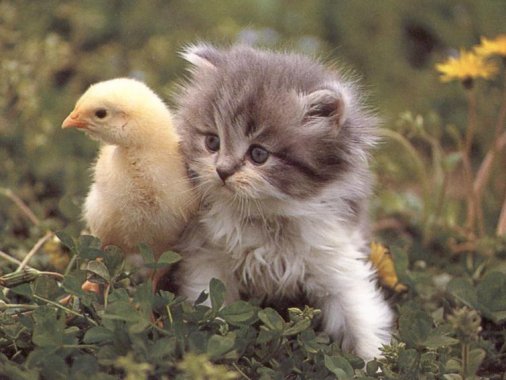


See?
It should be said, however, that the best thing about cats is this picture:
RATING(s):
Cats: 0 stars (out of 4)
Pictures of Kittens: ** (out of 4)
That one particular picture of a kitten being chased by little brown monsters that just never gets old: **** (out of 4)
BOTTOM LINE: With a dwindling economy, to which cats actively contribute nothing, don’t expect this “cat fad” to remain popular for much longer.

3 comments:
So, wait. Do you like cats or not?
/Jenn Graham
You just wrote a blog about my cat, which I find absolutely fantastic. Can you review dogs next so we can get a puppy? Or maybe, I don't know, unicorns!
i'm slightly offended! especially since i learned all this english just to read your blog!
meow.
- miles
Post a Comment