In light of the cookie’s relatively recent rise to popular main-stay, one might be shocked to learn that the origin of the cookie can be traced back to 7th Century Persia (in modern times known as the relatively cookie-less Iran). Well, it might have taken centuries for the cookie to find the spotlight, but it’s safe to say it’s making up for lost time!
I decided to investigate the trend myself and take the leap into the world of cookies! Thanks to the overwhelming and wide-spread success of the cookie, obtaining them is not as difficult as one might think. In fact, you can get pre-packaged, pre-made cookies at your local grocery store! These cookies come in different flavor and designs, and the brand names under which they are sold are often given “ethnic-sounding” names, lifted from cookie culture, lending them an air of supposed authenticity. Some of these include “Chips Ahoy!”, which include small pieces of chocolate (or “chips”) baked right into the cookies themselves; “Oreo”, which is actually two small cookies that create a “cookie sandwich” around a layer of hardened cream; and “E.L. Fudge”, conceptually similar to the Oreo, but with a basic sugar cookie with a slight vanilla flavor surrounding a firm chocolate filling. The E.L. Fudge is also notable for its artistic elegance, with immaculately carved designs of “elves”, who many superstitious cookie enthusiasts in the Middle Ages believed were responsible for the creation of their cookies.

The E. L. Fudge
In order to indoctrinate myself to cookie culture, I purchased a package of each of these three different types. Following the recommendations of my preparatory research, I also purchased a half gallon of “2% Milk”, which, when consumed in conjunction with the cookie, greatly enhances the experience of consumption. There are several ways to do this, but the two most popular include what cookie enthusiasts call “dunking”, where all or part of the cookie is dipped into a glass of milk for a period of several seconds, or, alternatively, one may eat part or all of the cookie “dry”, and subsequently drink the glass of milk to “wash it down”.
Of these three cookies, easily the most versatile (and thus potentially the most intimidating to the unaccustomed newbie) is the Oreo. Oreo enthusiasts often debate the “best” approach to consumption, and these debates usually revolve around whether or not to remove the chocolate cookie element from one side of the Oreo, exposing the hardened cream, and, subsequently, how to consume the two “halves”. The order of consumption as it relates to milk interaction is also often hotly disputed. As a relative novice, I tried many combinations of cookie-cream-milk, cookie-milk, cream-cookie-milk, and found little difference in overall enjoyment. Still, it is worth noting that this possible conflict may arise as one becomes more accustomed to regular cookie consumption.

The Oreo
So what’s the big deal? Well, the first thing that identifies the cookie and makes it stand out from other foods –some examples of other foods that come to mind are liver, boiled eggplant, and cabbage- is its notable and immediately apparent yumminess. Make no mistake about it: this is the cookie’s secret weapon. In almost all cases, when the cookie is properly prepared, yumminess will be central to its defining attributes.
Other than that, what exactly is a cookie??
Good question. A cookie is usually identifiable as having the following characteristics:
-It is round, and usually between 2 to 6 inches in diameter
-It is baked, and this is almost always true
-It is comprised primarily of butter, sugar, and flour (though some modern breakthroughs in cookie development have yielded the “vegan” or “gluten-free” cookie, which substitutes these for things like almond butter, and, I presume, magic)
As cookie making has progressed, however, the “round” formula has often been tweaked, most popularly in the case of the “rectangle” cookie. More daring, experimental cookie makers have even tried to “sculpt” their cookies into shapes like trees, butterflies, hearts, or even “men”, as shown below.
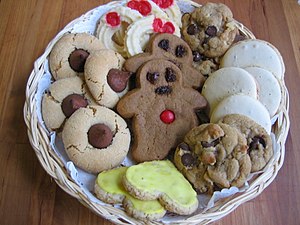
Some examples of unorthodox “Art” cookies
Cookies, especially the more authentic (and, WARNING: also more expensive!) “freshly baked” cookie, also often can be indentified by their pleasing aroma, especially when said aroma is detected during the baking process. The best way to experience this for yourself would be to visit a special proprietor of cookies, usually known as a “bakery”.

A Bakery
Bakeries should not be thought of as cookie-specific, however, as they also often peddle such goods as breads, cakes, and muffins. Think of the “bakery”, then, as something akin to your neighborhood Pan-Asian Vegan Organic eatery, where, just as you’d find quality Tofu Pad See Yue, organic tempeh skewers and low sodium soy sauce, you will find quality, usually very fresh cookies, but not necessarily the quality you might find from a bakery that either specializes in, or exclusively sells, cookies. There are several of these throughout the country, for instance Milk and Cookies Bakery in Greenwich Village (do not be confused by the name – they do not bake milk; for better context, see the third paragraph of this review), and Cow Chips, located in Seattle, Washington.
This all sounds great, you say, but are there downsides?
There are. And one should not embark on a cookie adventure without knowing them.
First, it should be clear that cookies, no matter how “healthy” they sometimes claim to be (many innovative cookie creators have based their recipes around oats and raisins, in an attempt to include nutritional content while minimizing the negative impact on the cookie’s deliciousness), cookies, even vegan cookies, are almost always extremely high in fat and carbohydrates. Like soy, the typical western physiology is not designed to process cookies properly, and thus the consumer may often find themselves the victims of rapid and unexpected weight gain. Also, crumbs.
The other downside is perhaps a product of the explosive and sudden popularity of cookies themselves; which is to say, this has lead to a lot of “experimentation” with cookie design and production, meaning that you may purchase what looks like the popular “chocolate chip” variety of cookie, but which turns out to be an “orange and coconut with beet chunks and jalapeno” cookie, resulting in a reaction from the consumer that can range from an involuntary sticking out of the tongue and tight closure of the eyes, accompanied by a “blech” sound, to an actual and forced spitting out of the cookie into the nearest available napkin. In some cases, this turn the consumer off from the very notion of cookie consumption for several seconds, perhaps even minutes.
To avoid such an unfortunate occurrence, new cookie consumers should not jump in head-first. Try eating cookies at home first, perhaps as an after-dinner treat, and stick to those offered in your grocery store. It is highly unlikely that these cookies will be in any way unorthodox.
Once comfortable with the general textures and flavors of traditional cookies, it is recommended you that you then explore “bakery” options. Often bakeries will sell cookies individually, and sometimes these cookies will not have signs describing the ingredients. For a visual point of reference, you are generally safe if you stick to tell-tale signs like pink or any pastel colored frosting and chocolate sprinkles. If unsure, ask the bakery attendant. What looks like chocolate chips may, in fact, be charred black olives. The risk of running into an unappealing cookie greatly increases if you are in a coastal area of the United States, but especially if you live in Brooklyn or The Bay Area.

Would you know just by looking at these cookies that they were made with scallions?
But don’t let this scare you off. Cookies are well worth the potential minor risk of a bad cookie experience. One bite of these exotic treats, and you’ll understand that, like that movie “Juno”, cookies really do live up to all the hype!
RATING: **** (out of 4)
YES, IT’S TRUE: Cookies are totally great.

1 comment:
(many innovative cookie creators have based their recipes around oats and raisins, in an attempt to include nutritional content while minimizing the negative impact on the cookie’s deliciousness)
jerk. lol.
but i did love this
Also, crumbs.
hilarious.
Post a Comment