As mentioned in the introduction, baseball was created in 1862 during the American Civil War by Union soldier Montgomery “Johnny Shoeshine” McCallister*. McCallister got the idea for baseball when he was shot in the shoulder by a Confederate officer and wished he’d been quick enough to deflect the bullet with his sword. Following an agonizing, anesthetic-free surgery to remove the bullet with a rusty, blunt knife, McCallister decided to focus his thunderous post-surgery adrenaline rush on realizing this very fantasy. He found a smooth, round, rock and a dead fellow soldier’s makeshift wooden crutch and “batted” the rock with the crutch*. Legend has it that McCallister batted the rock 986 feet, which technically would have made it the longest home run in history, but legend also has it that the rock went foul.*
As the rust from the knife gradually coursed through McCallister's bloodstream and eventually reached his brain, he went into a fever-induced coma where, apparently, he had visions of men standing on an oddly (some might say “randomly”) shaped field, throwing rocks at rods of wood and running about, catching and hitting them in turns. McCallister later recounted specific details of his bizarre, nonsensical dream to a Union doctor, such as the rock appearing white and almost perfectly round, adorned with textured red “stripes”, game “rules” based on the trajectory and angle at which a ball is hit and how it subsequently does or does not land within the boundaries of the park, a barely-understandable anomaly called a “balk”, and other features of a delightfully whimsical, nonsensical nature.

Above: The realization of McCallister’s hallucinatory “stripey rock”, now know as a “baseball”.
McCallister was shortly thereafter killed in the battle of Fort William Henry*, but not before his nightmare-induced “game” was recreated with actual “players”, at first as a joke and shortly thereafter as the only reasonable means of escapism from the drudgery, horror, and misery of war!
*This story may not actually be true, since I made it up, but it sounds true.

Above: An early game of Baseball (then called “the base-balling game”) is played by Civil War veterans in the late 19th century. Note how, just as in today’s game, the players pictured above are all unusually toned and athletic and display the aura of someone paid millions of dollars to play a game for 6 months out of the year!
And here we are, almost one hundred and fifty years later and “Baseball”, as it is known today, is still going strong!
Some may marvel at the lasting appeal of Baseball, but that appeal can most likely be attributed to the elegant, intuitive simplicity of the game’s rules, which can be quickly and eloquently summed up as such:
-Baseball is divided into nine segments called “innings”. In every “inning”, each team is given the opportunity to “bat”, meaning they are in the offensive position, or “pitch” and “field” meaning they are in the defensive position. Once a team records three “outs”, the teams switch sides. Once both teams have recorded three “outs” per side, a new inning begins.
-Outs can be recorded in several ways.
- First, a batter can “fly out”, which is not as cool as it sounds. In this case, a batter hits a ball and, before it touches the ground, it is caught by a fielder. The batter does not at any point fly during a fly out.
- Second, a batter can “ground out”. Once a ball is hit, the batter must run to a “base”, and as the rules dictate, this must first be “first base” (followed by “second base”, the elusive “third base”, etc.). If the ball is not caught but is easy for a fielder to “field” (which means the same thing in Baseball as it does in real life, i.e. “to do something with”), the fielder can throw the ball to the baseman who then must either tag the base with his foot or, in the even that this is not a force-out (see below), tag the runner (which is the new name given to the batter after he has batted) with his glove (or “mitt”) once the baseball is safely secured inside his glove.
-A force out occurs when a batter has no possible destination than the next base. Therefore, a batter running to first base will always be a force out situation. But if a runner is on second base during a base hit (see below) or a ground out, that runner is not in a force situation (as he is not required to move to third base as there is no one on first base who needs to advance to second base, where he is, theoretically, currently standing). Therefore, the baseman needs to tag this runner to record an out.
-A base hit occurs when none of the stuff mentioned above happens. - Lastly, a batter may strike out. In this case, the batter doesn’t have a chance to run to base at all (except when he does; see below**)! A batter must attempt to hit “pitches” thrown towards him by the “pitcher”, who stands the logical distance of 60 feet, 6 inches from the batter. If the pitch passes through the “strike zone” (see Fig. 13b) -which is roughly measured as the imaginary rectangle formed by the points denoted by the batter’s knee or belt or something depending on the day and what the umpire feels like saying, the batter’s elbow (maybe?) or shoulder or something like that, and the outermost points of home plate- and the batter does not swing at the pitch or swings and misses the pitch, it is a strike. If it does not, and the batter does not swing at the pitch, it is a ball. (If the batter amasses four "balls" before he is out or strikes out, the batter is automatically awarded first base)

Above: Fig. 13b - A computer rendering of a “strike zone”.
The batter can also hit a “foul ball”. A foul ball is one that is hit in such a way so as the ball does not travel within the boundaries of the first base line and the third base line, or it does but drops to the ground before passing third or first base and then rolls outside of the line before passing either of those bases (see Fig. 83c)
Above: Fig. 83c.-A computer rendering of potential “foul” and “fair” balls.
If a batter hits a foul ball, it counts as a strike, unless the batter already has two strikes, in which case it counts as a nothing, unless the batter either “bunts” the foul (a batting technique whereby the batter tries to hit or “stop” the ball with a stationary bat without “swinging” the bat, resulting in a slow ball that falls not far from the plate and is difficult to field and that a fast base runner will be able to safely make it to first base on) or “foul tips” the ball (whereby the batter makes minimal contact, barely affecting the momentum of the pitch) into the glove of the “catcher”. In both these cases, the batter has struck out and his team is charged with an out, **unless the catcher, ball in hand, fails to tag the batter after the third strike, in which case the batter can run to first base and the catcher must throw the ball to the first baseman who must then tag the batter-now-runner before he reaches first base safely.The team to not do all of this stuff the most, within the span of nine innings, wins! And it all moves along at a brisk pace that generally takes no more than 3 – 4 and a half hours at a time!
(Note: for an explanation of pitching, see this Wikipedia article, with its dozens of easy-to-navigate links to more detailed specifics)
There are, of course, other, more complicated rules, but once one grasps these graceful, logical basics, the rest can be learned over time.As someone who has enjoyed baseball for some time, I can say, first hand, that after just a few years of daily, semi-obsessive baseball watching, I was able to pick up and fully grasp about 83% of its rules!
Baseball enthusiasts are called “fans”, and much of Baseball is marketed towards these “fans”.

Above: Alyssa Milano –One of the many things marketed to Baseball “fans”.

Above: Bitter, despondent “fans” of the Philadelphia Phillies look on in horror, anger, and resentment after their team probably found a remarkably new and innovative way to lose something again, but still bought Phillies-branded hats and T-shirts, for some reason.
It is recommended that, if you wish to explore the possibility of becoming a "fan", you should designate a favorite team. Most major cities have a "home team", or one that "represents" that city and plays a majority of its games therein.

Above: The Los Angeles Angels of Anaheim, a Baseball team that represents Los Angeles, Anaheim, and unnecessarily cumbersome team names.
I decided to become a "fan" of the relatively obscure Boston Red Sox, a scrappy team of underdogs and relative unknowns with an annual payroll barely in excess of 140 million dollars.
My early experiences with the Red Sox proved a mixed bag. While the team would often come close to "winning it all" at various points during the first twenty or so years of my experimentation with "fan-being", they found impressive ways to "lose it all", often at the last minute and usually at the hands of another barely-on-the-radar team, the New York Yankees. In fact, it took a solid 25 years before I witnessed them "win it all" (this is when a team wins something called the "World Series", so named because it represents two of the world's most important countries: America and Toronto).
This can be frustrating for a fan, and so it is not recommended that any new comer to baseball ever become a "fan" of one of the following teams: The Chicago Cubs, The Tampa Bay Rays, The Pittsburgh Pirates, The Washington Nationals, The Kansas City Royals, The Cincinnati Reds, The Baltimore Orioles, The Texas Rangers, and most importantly The Philadelphia Phillies. If you live in one of these areas, you are advised to pay lip service to the White Sox (since they have actually won the World Series in the last 100 years), embrace the Atlanta Braves/leave Florida, stick to Football, be glad your team has only existed for three seasons, keeping talking about the George Brett years (and make plans to move to a real city), become a Cleveland Indians fan, keep talking about how great Camden Yards is and bask in the fact that everyone enthusiastically agrees with you, see what the Houston Astros are up to, and practice praying/cringing/swearing/developing your pitching staff/hoping the Eagles will have a better season, respectively.

Above: The author (in an official Boston Red Sox hat, one of the many fine products adorned with the team's logo) probably watching his team lose against some wretched, undeserving other team that has the audacity to challenge his own, while sitting in the "stands" at the Red Sox official park, "The Fen-way Park".
So how can I sum this up? What about Baseball makes it so great?
For one thing, it has rivalries. Some of these include The Red Sox/Yankees rivalry, the White Sox/Cubs rivalry, and the Phillies/Whichever team provides a convenient scapegoat to blame their perpetual, crushing futility on rivalry. Rivalries really enhance the enjoyment of Baseball, because instead of just watching a game and hoping your favorite team wins, you can pretend you have/have had any influence over the wins and losses of your team and their rival and also can make yourself feel better about yourself by proving to your rival team's fans that what they think is wrong.
There are, of course, other, more complicated rules, but once one grasps these graceful, logical basics, the rest can be learned over time.As someone who has enjoyed baseball for some time, I can say, first hand, that after just a few years of daily, semi-obsessive baseball watching, I was able to pick up and fully grasp about 83% of its rules!
Baseball enthusiasts are called “fans”, and much of Baseball is marketed towards these “fans”.
Above: Alyssa Milano –One of the many things marketed to Baseball “fans”.
Above: Bitter, despondent “fans” of the Philadelphia Phillies look on in horror, anger, and resentment after their team probably found a remarkably new and innovative way to lose something again, but still bought Phillies-branded hats and T-shirts, for some reason.
It is recommended that, if you wish to explore the possibility of becoming a "fan", you should designate a favorite team. Most major cities have a "home team", or one that "represents" that city and plays a majority of its games therein.
Above: The Los Angeles Angels of Anaheim, a Baseball team that represents Los Angeles, Anaheim, and unnecessarily cumbersome team names.
I decided to become a "fan" of the relatively obscure Boston Red Sox, a scrappy team of underdogs and relative unknowns with an annual payroll barely in excess of 140 million dollars.
My early experiences with the Red Sox proved a mixed bag. While the team would often come close to "winning it all" at various points during the first twenty or so years of my experimentation with "fan-being", they found impressive ways to "lose it all", often at the last minute and usually at the hands of another barely-on-the-radar team, the New York Yankees. In fact, it took a solid 25 years before I witnessed them "win it all" (this is when a team wins something called the "World Series", so named because it represents two of the world's most important countries: America and Toronto).
This can be frustrating for a fan, and so it is not recommended that any new comer to baseball ever become a "fan" of one of the following teams: The Chicago Cubs, The Tampa Bay Rays, The Pittsburgh Pirates, The Washington Nationals, The Kansas City Royals, The Cincinnati Reds, The Baltimore Orioles, The Texas Rangers, and most importantly The Philadelphia Phillies. If you live in one of these areas, you are advised to pay lip service to the White Sox (since they have actually won the World Series in the last 100 years), embrace the Atlanta Braves/leave Florida, stick to Football, be glad your team has only existed for three seasons, keeping talking about the George Brett years (and make plans to move to a real city), become a Cleveland Indians fan, keep talking about how great Camden Yards is and bask in the fact that everyone enthusiastically agrees with you, see what the Houston Astros are up to, and practice praying/cringing/swearing/developing your pitching staff/hoping the Eagles will have a better season, respectively.
Above: The author (in an official Boston Red Sox hat, one of the many fine products adorned with the team's logo) probably watching his team lose against some wretched, undeserving other team that has the audacity to challenge his own, while sitting in the "stands" at the Red Sox official park, "The Fen-way Park".
So how can I sum this up? What about Baseball makes it so great?
For one thing, it has rivalries. Some of these include The Red Sox/Yankees rivalry, the White Sox/Cubs rivalry, and the Phillies/Whichever team provides a convenient scapegoat to blame their perpetual, crushing futility on rivalry. Rivalries really enhance the enjoyment of Baseball, because instead of just watching a game and hoping your favorite team wins, you can pretend you have/have had any influence over the wins and losses of your team and their rival and also can make yourself feel better about yourself by proving to your rival team's fans that what they think is wrong.

Above: A likely Red Sox fan (though I'm only guessing, since everybody totally hates the Yankees) expresses a well-thought-out and reasonable argument about the Yankees and their skills as a team, as an organization, and as something that totally sucks.
As with all great rivalries, the Red Sox/Yankees rivalry is in no way just a tired, meaningless and irrational obsession among fans, but goes right to the core of the organizations themselves and includes bitter, hateful relations between the teams' actual players!
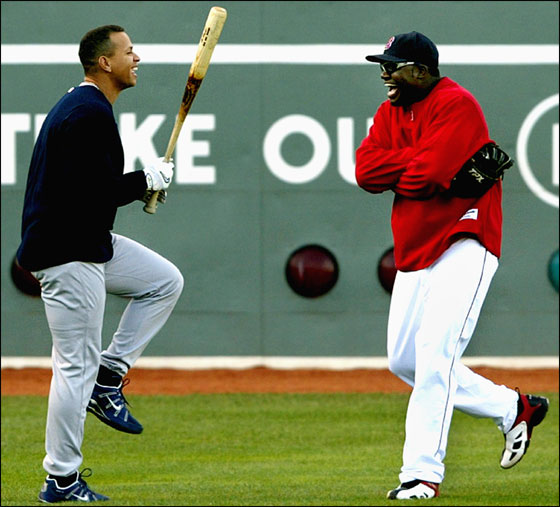
Above: Red Sox star David "Big Papi" Ortiz (at right) and Yankees star Alex "A-Rod" Rodriguez (at left) exchange bitter words. Papi probably was all like, "Hey, A-Rod! You suck, A-Rod" and then A-Rod was probably all like "What? No! Grrrrrrrrrrrrrrrrrrr! I'm totally gonna hit you with this bat!"
Another great thing about Baseball is the way it invites the popular activity of cheering.

Above: WHOOOOO!!!! Let's go (whatever this team's name is)!!!!!
Cheering can be directed towards teams, or even individual players.

Above: Ma-nny! Ma-nny! (Note, the blurry individuals in the background are fans "cheering", as evidenced by the raising of the arms over the head, a popular and common physical accompaniment to the vocalized "Whooooooooooooooo!")
On occasion, the "cheering" is done in a negative manner. This is often called "heckling" or "booing"

Above: New York Yankees Third Baseman Alex Rodriguez, a 3-time American League Most Value Player Award Winner, who last season batted .314 with 54 home runs and is widely considered the best overall player alive, and possibly ever, is mercilessly booed by New York Yankees fans after striking out, because he never ever does anything right and it's all his fault.
"Cheering" often happens when games are watched live, at the actual ballpark itself, where the enthusiasm of the hometown fans can actually have some indirect impact over the outcome of the game.

Above: Chicago Cubs fans, probably watching their team pull off another dominating post-season win, passionately cheer on their hometown heroes at the Cub's park,"Wrigley Field"
Quite inexplicably, cheering can also take place at sports bars, where fans often gather to watch games together, but on televisions. In such places, even ones with very thin walls located very closely to the stadium or park in which the games is being played, it is highly unlikely that the players will be able to hear the cheering fans, making the very act symbolic at best.
One downside to Baseball is that, on extremely rare occasions, fans can become so passionate that they start taunting or even becoming physically violent toward other fans. To help curb this problem, most venues sell beer, a chemical depressant, to help fans remain docile and calm.
Unfortunately, while this is an effective method of preventing fights among fans, players are not allowed to drink alcohol on the field, which can be problematic, especially among A.J. Pierzynski.

Above: Former Cubs catcher Michael Barrett finally does what everybody has secretly always wanted to do.
The other downside is that Major League Baseball is only played for almost exactly half a year, every year, and with a mere 162 games per season, one may feel short-changed by missing perhaps three or four of these games due to other important personal matters, such as work, interpersonal relationships, and occasionally not drinking.
But, truth be told, none of these downsides should in any way deter you from a budding interest in this popular new sport. No matter your team, nor where you watch the game, Baseball is pretty great.
And look, if this picture doesn't make you feel good to your core about absolutely everything in life, I don't know what will:

Rating: **** (out of 4)
Bottom Line: I live for this.

2 comments:
Thanks for this. It made me laugh out loud. A great reminder of why, against all reason, I love baseball.
I hope to one day be counted as a nothing
Post a Comment